In terms of the economy and flagship sectors, Minsk is the capital and largest city of the Republic of Belarus, serving as the nation's political, economic, scientific, educational, and cultural center. Located along the Svislach River in the central region of Belarus, Minsk boasts a history spanning over 950 years and is one of the most important urban centers in Eastern Europe. According to data from the official portal of the Minsk City Government, the city has a population of over 2 million and contributes a major share to the national economy. Following extensive reconstruction after World War II, Minsk has developed into a modern metropolis with comprehensive infrastructure, vast green spaces, and a highly developed public transit network. The city is widely recognized as Belarus's hub for scientific research, technology, and high-quality human resource training, housing numerous research institutes, universities, and dedicated technology parks.
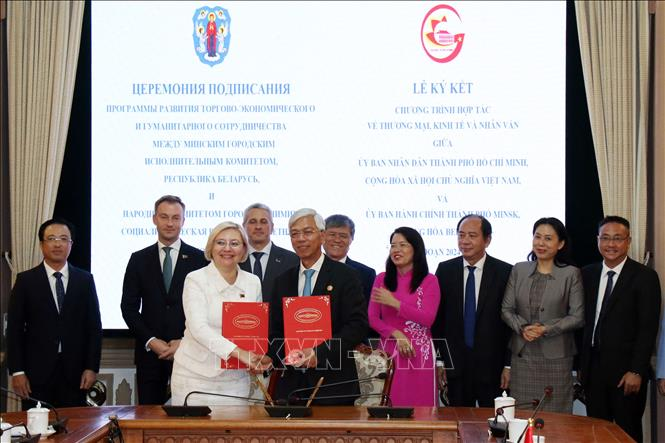
Leaders of Ho Chi Minh City and Minsk City (Belarus) sign a cooperative agreement. - Photo: Vietnam News Agency
Economically, Minsk serves as the industrial engine of Belarus, with prominent strengths in heavy machinery manufacturing, industrial equipment production, information technology, electronics, biotechnology, and logistics. The city houses the headquarters of many leading Belarusian state-owned enterprises and industrial conglomerates, while also hosting the Belarus Hi-Tech Park (HTP)—one of the largest IT and software development hubs in Eastern Europe. On the basis of the friendly cooperative relations between the two localities, Ho Chi Minh City aims to expand cooperation with Minsk in five key focus areas:
1. Manufacturing and High Technology: Strengthening cooperation in machinery manufacturing, industrial equipment production, automation, and technology transfer to enhance the manufacturing capabilities of enterprises from both localities.
2. Information Technology and Digital Transformation: Promoting connectivity among tech enterprises, research centers, and high-tech parks to develop software, Artificial Intelligence (AI), cybersecurity, and digital transformation solutions to serve smart city development.
3. Science, Education, and Human Resource Training: Expanding cooperative programs between universities and research institutes; enhancing exchanges of experts, faculty, and students in engineering, technology, and management fields.
4. Trade, Investment, and Logistics: Supporting business matchmaking, promoting trade, expanding market reach, and enhancing logistics cooperation between Ho Chi Minh City and the economic hubs of Belarus and the Eurasian region.
5. Culture and People-to-People Exchanges: Promoting exchanges in culture, art, sports, tourism, and youth cooperation to enhance mutual understanding and consolidate the social foundation for long-term cooperative relations.