Economic Profile and Key IndustriesShanghai is China's largest municipality directly under the Central Government, with a population of more than 24 million. It serves as a key driver of the country's modernization, innovation, and global integration within the dynamic Yangtze River Delta Economic Region.According to the Shanghai Municipal Statistics Bureau (SMSB), Shanghai possesses one of the world's most competitive economic structures, underpinned by internationally integrated financial, commercial, and professional service sectors.The Municipality's principal industries include international finance, maritime logistics, high-value professional services, advanced robotics, and industrial automation, accounting for approximately one-third of China's robotics industry. Under its current development strategy, Shanghai is rapidly strengthening its position as a global innovation and knowledge hub through the advancement of the digital economy and the large-scale application of artificial intelligence across manufacturing, healthcare, retail, and next-generation urban services.
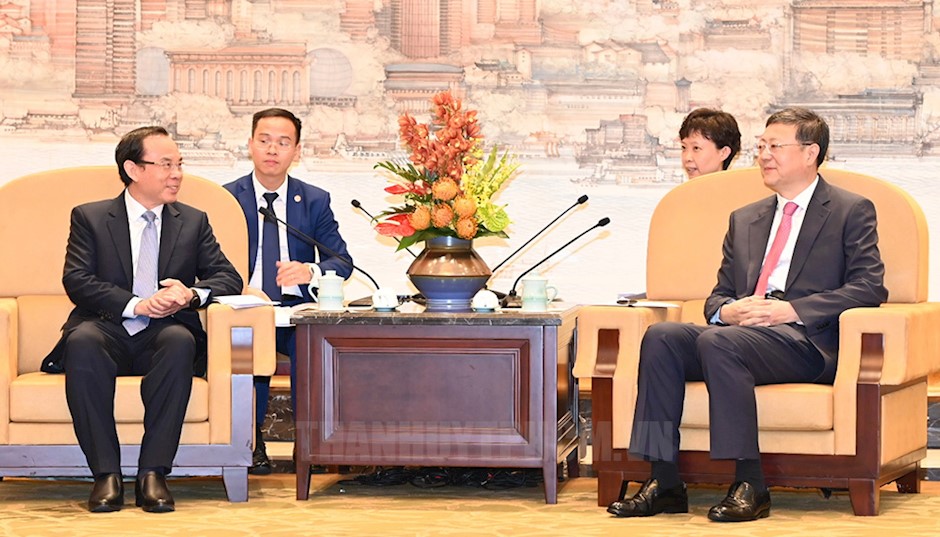
Mr. Nguyen Van Nen, former Secretary of the Ho Chi Minh City Party Committee, and Mr. Chen Jining, Secretary of the Shanghai Municipal Committee of the Communist Party of China, during their official meeting. Photo: Ho Chi Minh City Party Committee Portal
Over the years, cooperation between Ho Chi Minh City and Shanghai has delivered substantial and far-reaching outcomes in trade, investment, finance, infrastructure connectivity, and cultural and knowledge exchange.Since the establishment of bilateral economic cooperation mechanisms, Shanghai has further consolidated its position as a global economic hub. The Port of Shanghai has consistently ranked as the world's busiest container port by throughput, while the Shanghai Free Trade Zone (Shanghai FTZ) has served as a national pioneer in institutional and regulatory reform.Recent cooperation has been marked by regular business forums, investment promotion conferences, and commercial networking events, creating favourable conditions for Shanghai-based enterprises to expand their long-term investments in Ho Chi Minh City across real estate, high-tech manufacturing, logistics, and e-commerce.
Looking toward the future, particularly as Ho Chi Minh City advances the development of an International Financial Centre and an innovation-driven metropolitan hub for Southeast Asia, the City seeks to further strengthen strategic partnerships and attract investment from Shanghai in the following priority areas:
Finance, Banking, and the International Financial Centre: Encourage leading investment funds, multinational financial institutions, and commercial banks to participate in the development of the Ho Chi Minh City International Financial Centre, with particular emphasis on asset management, capital markets, and modern financial services.
FinTech and Comprehensive Digital Transformation: Promote cooperation in financial technology, digital payment solutions, big data governance, and the development of intelligent digital business ecosystems for enterprises from both cities.
Smart Logistics and International Supply Chains: Strengthen cooperation in maritime transport infrastructure, multimodal cross-border connectivity, and the transfer of advanced smart port management solutions drawing on the experience of the Port of Shanghai.
Artificial Intelligence (AI) and High Technology: Promote joint research, technology transfer, industrial automation, and the development of advanced AI applications in manufacturing, healthcare, and digital urban governance.
Smart Cities and the Green Economy: Enhance cooperation in energy-efficient urban management systems, modern urban infrastructure, and low-carbon solutions that support sustainable green growth.