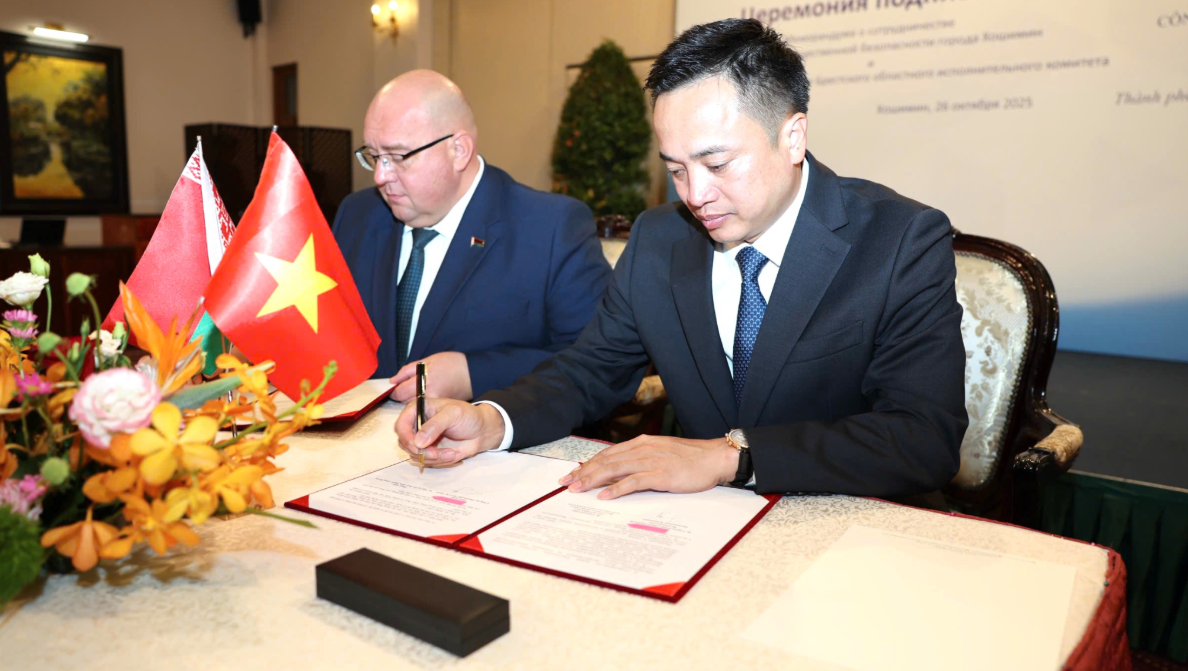
Representatives of the Ho Chi Minh City Police Department and the Department of Internal Affairs of the Executive Council of Brest signed a Memorandum of Understanding. Photo: Công an (People's Public Security) Newspaper.
Brest is a major port city in the Brittany Region of France, with a metropolitan population of more than 200,000. It plays a pivotal role in the region's maritime economy and innovation ecosystem. The city's economy is driven by port activities, ocean research, maritime technologies, logistics, higher education, innovation, marine industries, urban services, and coastal development. By bringing together a modern seaport, leading research institutions, universities, technology enterprises, and innovation programmes, Brest has developed a well-integrated blue economy ecosystem within the Brittany Region. This comprehensive ecosystem offers valuable experience for Ho Chi Minh City in areas such as port management, riverfront and coastal planning, maritime logistics, ocean data, and climate-resilient urban development.
Cooperation between Ho Chi Minh City and Brest has been advanced through official exchanges, working visits, and discussions on urban development and port cooperation. According to VietnamPlus in 2013, Ho Chi Minh City expressed its interest in learning from Brest's experience and strengthening cooperation in urban development and seaport management. This represents a highly practical area of collaboration, as Ho Chi Minh City is a major river and coastal metropolis with an extensive network of seaports and inland waterways, while facing increasing demands for logistics development, climate adaptation, and the sustainable revitalization of its riverfront and coastal areas. At the local level, Brest has also gained international recognition for its initiatives in the sustainable blue economy and marine spatial planning, demonstrating expertise that can provide valuable support for future cooperation programmes between the two cities.
For Ho Chi Minh City, Brest is a highly suitable partner for advancing specialized cooperation in the blue economy, port management, ocean research, riverfront and coastal planning, and climate resilience. Brest's experience in developing port infrastructure, integrating marine research with innovation, and promoting a sustainable blue economy offers valuable insights for Ho Chi Minh City as it explores new growth models following the expansion of its urban development space. At the same time, cooperation in education, scientific research, and cultural exchanges can further strengthen mutual understanding and deepen subnational ties between Viet Nam and the French Republic, contributing to a long-term and sustainable partnership between the two localities.
Looking ahead, particularly within the framework of the 3rd Ho Chi Minh City Friendship Dialogue (FD 2026), Ho Chi Minh City seeks to further expand its cooperation framework with Brest Metropolis by encouraging investment, technology transfer, and the sharing of governance expertise in the following five priority areas:
Blue Economy and Port Development: Promote the exchange of expertise in port management, maritime services, maritime logistics, supply chain development, and seaborne trade connectivity.
Ocean Research and Marine Data: Strengthen collaboration among research institutes, universities, technology enterprises, and experts in marine science, ocean data, marine environmental management, and climate change.
Riverfront and Coastal Planning, and Climate Resilience: Share experience in waterfront regeneration, coastal urban development, green–blue infrastructure planning, and climate adaptation to enhance resilience against environmental risks.
Marine Renewable Energy and Innovation: Explore cooperation in offshore renewable energy, maritime technologies, blue economy start-ups, engineering services, and innovative solutions supporting the sustainable development of port cities.
Education, Culture and People-to-People Exchanges: Expand student and expert exchanges, joint research programmes, cultural initiatives, and activities that promote the maritime heritage and cultural identities of both localities.