Sakai and Vietnam have engaged in exchanges in various fields through the Consulate General of the Socialist Republic of Vietnam in Osaka, which is located in Sakai City. Building on these exchanges, the Ho Chi Minh City People's Committee (formerly Ba Ria-Vung Tau Province) and the Sakai City Government signed a Memorandum of Understanding (MoU) on cooperation regarding decarbonization and related fields in 2023. This MoU aims to establish a mutually beneficial cooperative relationship in the environmental field toward the development of a decarbonized city and a circular economy.
Sakai is a government ordinance-designated city in Osaka Prefecture, located in the Kansai region of Japan and adjacent to Osaka City.
The area of present-day Sakai City has a history spanning more than 10,000 years. During the medieval period, it flourished as one of Japan’s leading international trade hubs and played an important role in commerce with China, the Korean Peninsula, and the countries of Southeast Asia.
Throughout its long history, Sakai has nurtured many renowned traditional industries including production of knives and other bladed tools, incense making, and cotton bleaching and hand-dying.
In addition, Sakai possesses unique cultural heritage. One representative example is the Mozu-Furuichi Kofun Group, which was inscribed as a UNESCO World Cultural Heritage Site in 2019.
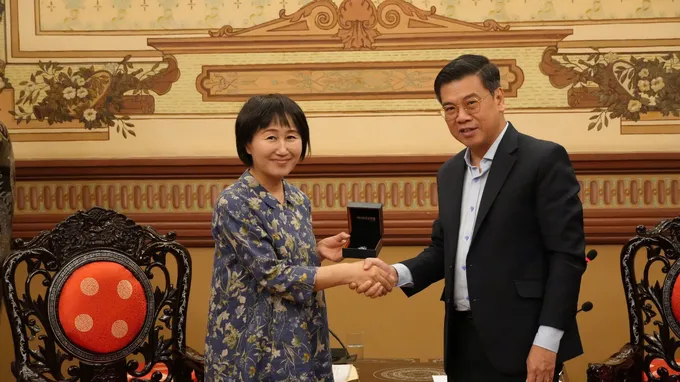
Former Vice Chairman of the Ho Chi Minh City People's Committee Le Thanh Liem presents a souvenir to Ms. Emiko Hazama, Former Vice Mayor of Sakai City - Photo: Saigon Economic Times
Economically, Sakai has a significant concentration of diverse industries, including petrochemicals, energy, metals, and machinery, making it one of Japan’s leading industrial clusters. Furthermore, companies with advanced technologies and environmental technologies continue to establish operations in the city, contributing to the growth of high value-added industries.
On the basis of each side's potential and development needs, Ho Chi Minh City aims to expand cooperation with Sakai in five key focus areas:
1. High-Tech Industries and Advanced Manufacturing: Promoting cooperation among enterprises, industrial parks, and research centers to develop precision machinery, automation, new materials, and smart manufacturing.
2. Environment and Green Urban Development: Strengthening the exchange of experiences in waste management, the circular economy, energy conservation, carbon emission reduction, and climate change response.
3. Innovation and Digital Transformation: Partnering to build an innovation ecosystem, connecting startups, research centers, and technology support organizations to drive digital transformation in urban governance and manufacturing.
4. High-Quality Human Resource Training: Expanding technical training programs, industrial management, environmental technology, and expert exchanges to meet the development demands of the digital economy and modern industries.
5. Cultural Exchanges and Tourism: Enhancing youth, educational, cultural, and tourism exchanges, while promoting heritage values to consolidate the solid social foundation for long-term cooperation between the two localities.
11:10:08 query returned open=false
11:10:55 dblclick "Sakai is a government ordinance-designated city in Osaka Prefecture, located in the Kansai region of Japan and adjacent to Osaka City.

The area of present-day Sakai City has a history spanning more than 10,000 years. During the medieval period, it flourished as one of Japan's leading international trade hubs and played an important role in commerce with China, the Korean Peninsula, and the countries of Southeast Asia.

Throughout its long history, Sakai has nurtured many renowned traditional industries including production of knives and other bladed tools, incense making, and cotton bleaching and hand-dying.

In addition, Sakai possesses unique cultural heritage. One representative example is the Mozu-Furuichi Kofun Group, which was inscribed as a UNESCO World Cultural Heritage Site in 2019.

Economically, Sakai has a significant concentration of diverse industries, including petrochemicals, energy, metals, and machinery, making it one of Japan's leading industrial clusters. Furthermore, companies with advanced technologies and environmental technologies continue to establish operations in the city, contributing to the growth of high value-added industries.

On the basis of each side's potential and development needs, Ho Chi Minh City aims to expand cooperation with Sakai in five key focus areas:" sidepanelOpen=false autoUpdate=true isAdv=true
11:14:49 query returned open=false
11:15:33 query returned open=false
11:16:40 dblclick "Former Vice Chairman of the Ho Chi Minh City People's Committee Le Thanh Liem presents a souvenir to Ms. Emiko Hazama, Former Vice Mayor of Sakai City - Photo: Saigon Economic Times
" sidepanelOpen=false autoUpdate=true isAdv=true
11:16:47 dblclick "Former Vice Chairman of the Ho Chi Minh City People's Committee Le Thanh Liem presents a souvenir to Ms. Emiko Hazama, Former Vice Mayor of Sakai City - Photo: Saigon Economic Times" sidepanelOpen=false autoUpdate=true isAdv=true
11:17:32 query returned open=false
11:17:33 dblclick "Former Vice Chairman of the Ho Chi Minh City People's Committee Le Thanh Liem presents a souvenir to Ms. Emiko Hazama, Former Vice Mayor of Sakai City - Photo: Saigon Economic Times" sidepanelOpen=false autoUpdate=true isAdv=true
11:17:42 dblclick "Former Vice Chairman of the Ho Chi Minh City People's Committee Le Thanh Liem presents a souvenir to Ms. Emiko Hazama, Former Vice Mayor of Sakai City - Photo: Saigon Economic Times
" sidepanelOpen=false autoUpdate=true isAdv=true