Within Ho Chi Minh City's broader network of partnerships with localities across the Russian Federation, the Nenets Autonomous Okrug is not a major metropolitan partner. However, it offers valuable opportunities for sector-specific cooperation and knowledge exchange in highly specialized fields, particularly those requiring advanced technical expertise and experience in managing infrastructure and economic activities in challenging climatic environments.
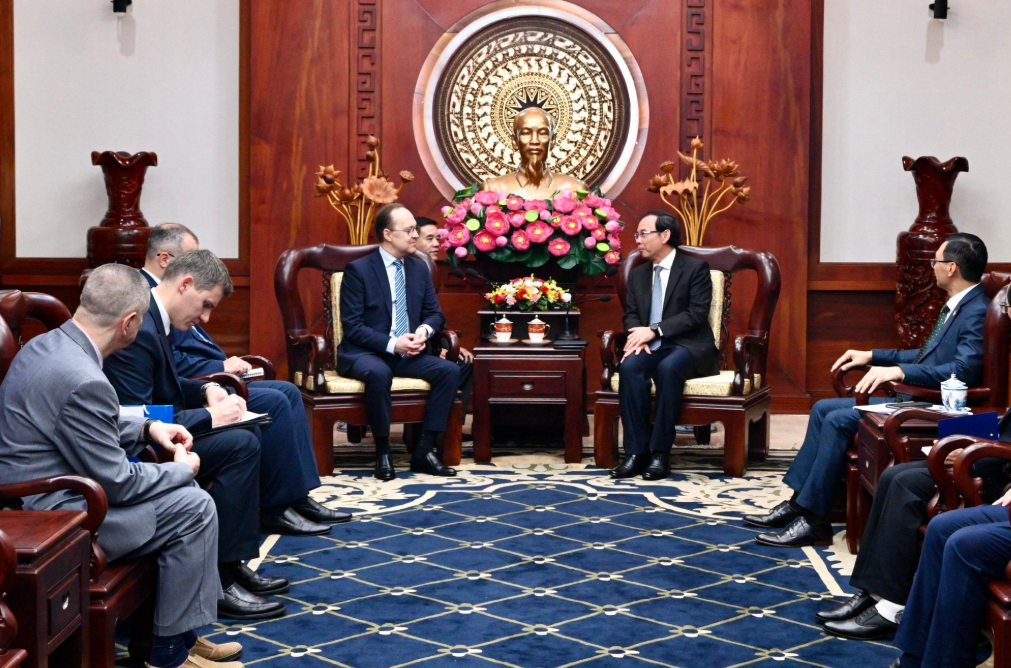
Former Secretary of Ho Chi Minh City Party Committee Nguyen Van Nen receives Russian Ambassador to Vietnam. - Photo: Dan Viet Newspaper
In terms of economic development and key industries, the Nenets Autonomous Okrug is a sparsely populated region with a vast territory located in the Russian Arctic, occupying a strategic position within the Russian Federation's northern development corridor. Its economy is closely linked to the oil and gas industry, energy, natural resource extraction, cold-climate logistics, fisheries, engineering infrastructure, and industrial support services. According to the Region's investment promotion portal, the Nenets Autonomous Okrug plays a significant role in Russia's Arctic development strategy, supported by strong economic indicators in regional gross product, fixed capital investment, and hydrocarbon-based industries. Accordingly, the Region's comparative advantages lie not in the size of its domestic market but in its specialized expertise in natural resources, energy development, infrastructure operation under extreme climatic conditions, and technical services for resource-based industries.
One of the Region's notable strengths is its extensive experience in Arctic economic development and oil and gas operations, as highlighted through its investment promotion initiatives and regional development programmes. These strengths demonstrate the Nenets Autonomous Okrug's expertise in Arctic governance, investment attraction in the energy and natural resources sectors, and infrastructure development in harsh climatic environments. For Ho Chi Minh City, the partnership offers valuable opportunities for sector-specific cooperation, particularly through the exchange of expertise, professional networking, technical training, and collaboration in energy, engineering services, specialized logistics, and cold-chain supply systems.
For Ho Chi Minh City, cooperation with the Nenets Autonomous Okrug is best suited to a focused, knowledge-intensive, and technically specialized partnership rather than large-scale market-driven cooperation. As the City continues to strengthen its technical service industries, logistics capabilities, supply chain networks, workforce development, and business connectivity with the Russian Federation, the Nenets Autonomous Okrug can serve as a valuable reference partner in energy development, infrastructure operation under extreme environmental conditions, and the management of complex technical service networks. These areas also provide a strong foundation for thematic exchanges, technical workshops, business matchmaking, and professional training programmes.
Looking ahead, particularly within the framework of the 3rd Ho Chi Minh City Friendship Dialogue (FD 2026), Ho Chi Minh City aims to broaden its cooperation framework with the Nenets Autonomous Okrug by encouraging investment, technology transfer, and the sharing of management expertise in the following five priority areas:
Energy and Oil & Gas: Promote the exchange of expertise in energy management, engineering services, oil and gas technologies, and project management models for operations in geographically and climatically challenging environments.
Cold-Climate Logistics and Specialized Supply Chains: Strengthen cooperation in infrastructure operation, warehousing, preservation technologies, transportation systems, and specialized supply chain management for cold-climate and technically demanding environments.
Fisheries and the Arctic Economy: Explore opportunities for cooperation in fisheries, cold-region food preservation and processing, product standardization, and the trade of Arctic and cold-climate products.
Technical Workforce Development: Enhance cooperation through expert exchanges and technical training programmes in the fields of energy, infrastructure, logistics, engineering services, and the operation of specialized equipment.
People-to-People Exchanges and Arctic Studies: Promote cultural and educational exchanges, regional studies, and cooperation in research on the Russian Arctic and other geographically distinctive regions of the Russian Federation.