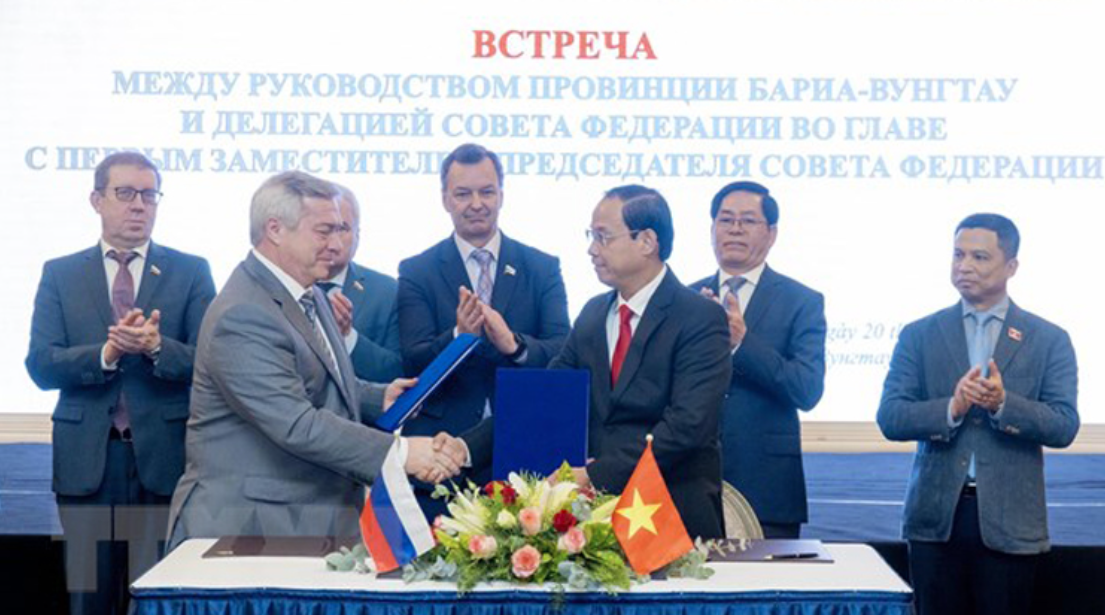
Leaders of the former Ba Ria–Vung Tau Province (now part of Ho Chi Minh City) and Rostov Region sign a memorandum of cooperation between the two localities. Photo: Phap Luat Newspaper
In terms of economic development and key industries, Rostov Region has a population of more than four million and serves as one of the principal economic gateways in southern Russia. The Region benefits from a well-developed multimodal transport network comprising highways, railways, seaports, river ports, and an international airport, providing strong connectivity for trade, freight transportation, and import-export activities. Rostov Region's economy is driven by agriculture, manufacturing, trade, logistics, food processing, agricultural exports, and business support services. According to regional investment promotion sources, Rostov is recognized as one of the Russian Federation's leading industrial and agricultural regions. Its Investment Portal of Rostov Region (www.invest-don.ru) provides comprehensive information on investment maps, investor support mechanisms, and investment opportunities. These strengths offer considerable potential for Ho Chi Minh City to expand cooperation in agriculture, food processing, manufacturing, logistics, seaport and inland waterway development, and business connectivity.
A notable aspect of the partnership is the growing cooperation between Rostov Region and Vietnamese localities, alongside the broader network of educational and economic collaboration between Viet Nam and the Russian Federation. Vietnamese sources indicate a shared commitment to expanding cooperation across a wide range of sectors, while the activities of the Vietnam–Russia Association of Economic Universities highlight opportunities for strengthening academic cooperation, workforce development, and applied research. From an investment perspective, the Investment Portal of Rostov Region serves as an important reference platform, offering detailed information on investment opportunities, policy incentives, and investor support services.
For Ho Chi Minh City, these resources provide a solid basis for enhancing business connectivity and fostering cooperation in agriculture, manufacturing, logistics, education, culture, and science and technology. For Ho Chi Minh City, Rostov Region can serve as a strategic partner in expanding cooperation with southern Russia. The Region’s strengths in agriculture and agricultural exports complement Ho Chi Minh City's efforts to enhance trade in food and agricultural products, while its well-developed seaport, river port, and multimodal transport infrastructure offer valuable experience in logistics, freight transportation, and supply chain development. At the same time, Rostov's higher education institutions and the growing network of academic cooperation between Viet Nam and the Russian Federation provide a solid foundation for expanding collaboration in workforce development, applied research, and academic exchange. These partnerships can support practical cooperation in areas such as economic governance, logistics, international trade, and food processing industries.
Looking ahead, particularly within the framework of the 3rd Ho Chi Minh City Friendship Dialogue (FD 2026), Ho Chi Minh City aims to broaden its cooperation framework with Rostov Region by encouraging investment, technology transfer, and the sharing of management expertise in the following five priority areas:
Agriculture and Agricultural Exports: Strengthen cooperation in the trade of grains, food products, processed agricultural goods, quality standards, and logistics supporting agricultural supply chains.
Seaport and River Port Logistics, and Multimodal Transport: Promote the exchange of expertise in the development and management of seaports, river ports, railways, highways, warehousing, freight transportation, and integrated regional supply chains.
Manufacturing Industries and Industrial Equipment: Foster partnerships in machinery, industrial equipment, materials, supporting industries, contract manufacturing, and engineering services.
Education, Science and Technology, and Applied Research: Expand cooperation among universities through expert exchanges, joint applied research programmes, and workforce development in logistics, economic governance, and international trade.
Culture, Business Cooperation and Investment Promotion: Enhance cultural exchanges, organize business forums, facilitate business matchmaking between importers and manufacturers, and promote investment opportunities aligned with the comparative strengths and development priorities of both sides.