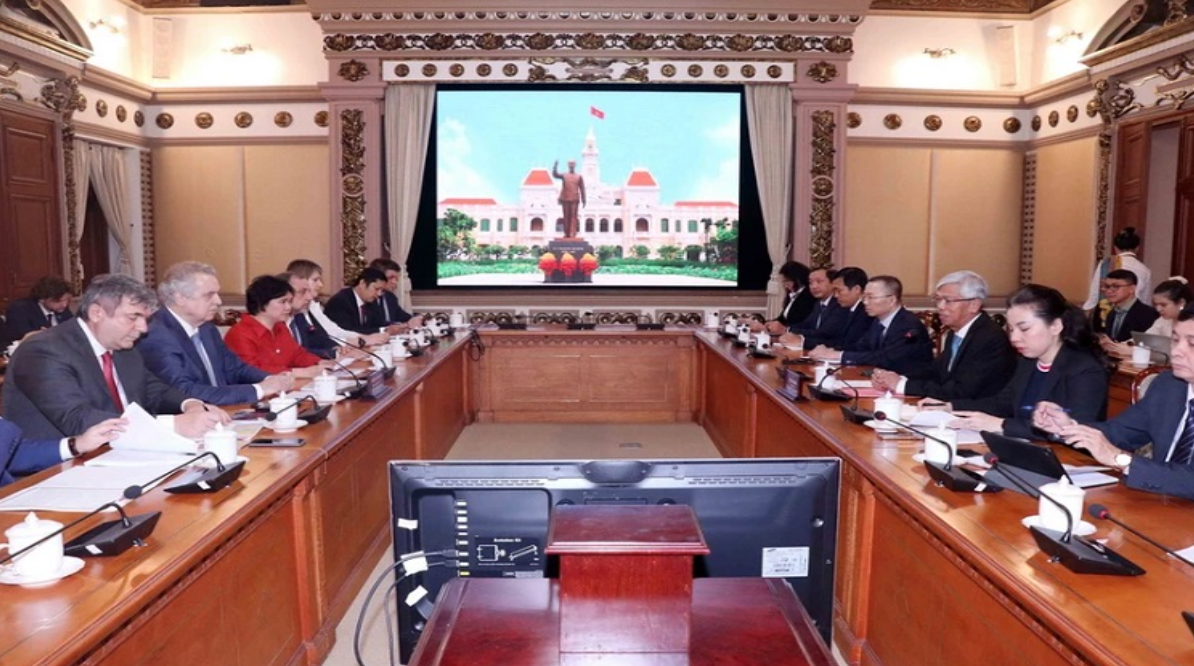
Photo: Meeting between the leadership of Ho Chi Minh City People's Committee and the high-level of Saint
Photo: Vietnam News Agency (VNA)
In terms of economic development and key industries, Saint Petersburg is Russia's second-largest city, with a population of over five million. It is a leading centre for culture, science, education, industry, logistics, maritime transport, and tourism. Strategically located on the Baltic Sea, the city serves as one of the Russian Federation's principal gateways to Europe and international trade routes. Saint Petersburg's economy is underpinned by strengths in advanced manufacturing, shipbuilding, energy, oil and gas, high technology, port logistics, urban services, healthcare, higher education, and heritage tourism. The city is also home to the Saint Petersburg Special Economic Zone (SEZ), which provides a dedicated platform for high-tech industries and innovation-driven projects. Supported by preferential investment policies, the SEZ has become an important destination for investors engaged in the development and production of high-value technology products.
A key highlight of cooperation between the two cities has been the steady expansion of exchanges through high-level visits, virtual conferences, investment promotion activities, and sector-specific cooperation programmes. Official sources on the Ho Chi Minh City–Saint Petersburg partnership identify five priority areas of cooperation: economic development; environment and water management; education, training and science; culture; and tourism. During high-level exchanges, both sides have also emphasized strengthening business connectivity by identifying enterprises in Saint Petersburg interested in the Ho Chi Minh City market, while promoting cooperation in trade, shipbuilding, energy, oil and gas, education, and tourism. These initiatives demonstrate that the partnership has evolved beyond traditional friendship exchanges into a practical framework for economic and technical cooperation.
For Ho Chi Minh City, Saint Petersburg offers significant opportunities for collaboration across three strategic dimensions: economic and business connectivity, cultural and educational exchanges, and sustainable urban governance. With its strong science and technology ecosystem, world-class universities, advanced port infrastructure, extensive experience in managing a historic metropolitan city, and strategic position as a gateway to the Baltic region, Saint Petersburg is well positioned to serve as a valuable partner for Ho Chi Minh City in areas such as logistics, smart city development, water management, heritage conservation, cultural tourism, advanced healthcare, and high-tech industries.
Looking ahead, particularly within the framework of the 3rd Ho Chi Minh City Friendship Dialogue (FD 2026), Ho Chi Minh City seeks to further expand cooperation with Saint Petersburg and encourage investment, technology transfer, and the sharing of management expertise in the following five priority areas:
Education, Science and Innovation: Strengthen cooperation in higher education, scientific research, student and expert exchanges, and joint programmes in technology, healthcare, applied sciences, and urban governance.
Logistics and Port Infrastructure: Promote the exchange of expertise in port management, maritime transport, supply chain development, international logistics, and trade connectivity with the Baltic region.
Healthcare, High Technology and the Saint Petersburg Special Economic Zone: Expand cooperation in medical equipment, biotechnology, specialized healthcare services, and innovation-driven projects within the framework of the Saint Petersburg Special Economic Zone (SEZ).
Culture, Tourism and Heritage: Enhance collaboration in cultural and artistic exchanges, publishing, heritage tourism, destination promotion, and people-to-people exchange programmes between the two cities.
Environment, Water Management and Smart Cities: Promote the exchange of best practices in water resource management, urban environmental protection, sustainable infrastructure development, digital transformation in urban governance, and the application of smart technologies in public services.