Jeollanam serves as one of South Korea's core heavy industry and maritime logistics hubs, with a GRDP of approximately USD 67.1 billion and a population of 1.8 million. The province boasts world-scale petrochemical and metallurgical complexes in Yeosu and Gwangyang. Notably, the Port of Gwangyang stands as one of the nation's most advanced automated container ports, providing absolute advantages in international shipping and maritime warehousing. Moving into the new era, Jeollanam is leading the nation in green energy, driven by mega-scale projects in offshore wind power, solar energy, and the green hydrogen economy. Furthermore, the province remains the agricultural and culinary capital of South Korea, underpinned by the application of advanced organic farming and high-tech aquaculture technologies.
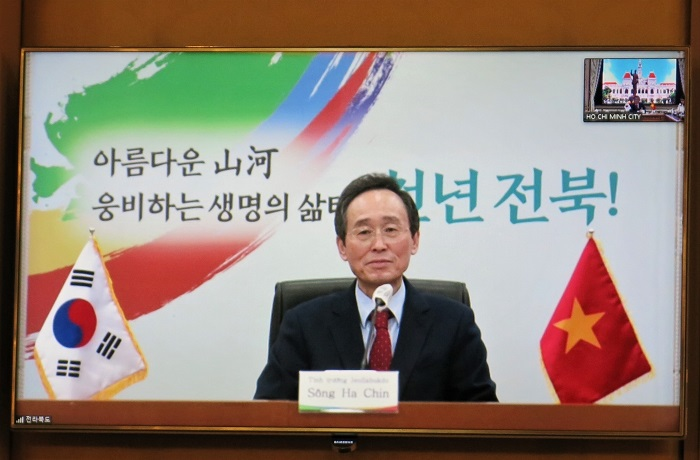
Former Jeollabuk-do Governor Song Ha-jin shares his expectations for promoting cooperation between South Korean and Vietnamese enterprises.
- Photo: Ho Chi Minh City
Over nearly three decades, cooperation between the two localities has achieved many substantive milestones across three core pillars. In trade, both sides have continuously facilitated multi-sectoral promotions, connected import-export supply chains, and promoted Jeollanam’s signature agricultural products in Ho Chi Minh City. In people-to-people diplomacy, annual exchange programs for Jeollanam youth and young public officials have become a bright highlight, deepening friendships between the future generations. Most notably, the two localities actively exchange urban management solutions, where Jeollanam’s models of green port infrastructure and carbon-neutral industrial parks offer highly practical experience to support Ho Chi Minh City's sustainable urban upgrades.
Looking toward the future, particularly within the framework of the 3rd Ho Chi Minh City Friendship Dialogue in 2026 (FD 2026), the City is widening its corridors to attract direct investment (FDI) and foster strategic alliances with partners from Jeollanam in five key sectors:
1. Offshore Wind and Renewable Energy: Partnering in the construction of clean power grids, transferring green hydrogen production technologies, and implementing carbon emission reduction solutions.
2. Maritime Logistics and Smart Ports: Exchanging automated port operation solutions, optimizing maritime transport supply chains, and connecting cargo flows between the Port of Gwangyang and Southern Vietnam's logistics hubs.
3. High-Tech Agriculture and Digital Farming: Transferring smart greenhouse technologies, automation in cultivation, and the application of biotechnology in high-end agricultural and aquatic product processing.
4. Green Petrochemicals and Advanced Materials: Attracting investment into eco-friendly chemical manufacturing and next-generation composite materials within specialized industrial parks.
5. Youth Exchanges and the Cultural Economy: Continuing to maintain and upgrade exchange programs for students, young public officials, and organizing bilateral culinary and cultural festivals to strengthen enduring friendly ties.