Stemming from that requirement, on April 30, 2025, the Politburo issued Resolution No. 66-NQ/TW on innovating law-making and enforcement to meet national development requirements in the new era. The Resolution affirms that law-making and enforcement work constitutes the core content of building the Socialist Rule-of-Law State of Vietnam, while defining this as the 'breakthrough of breakthroughs' in perfecting the development institution, creating a solid legal foundation for the country's rapid and sustainable development in the new phase.
The Resolution sets the goal of building a legal system that is democratic, fair, synchronous, unified, public, transparent, stable, feasible, and accessible; ensuring human rights and citizens' rights; creating a favorable investment and business environment; while unleashing and promoting all development resources. Furthermore, the Resolution emphasizes the requirement for comprehensive innovation in law-making and enforcement toward a citizen- and business-centric approach, strengthening decentralization and delegation of power combined with power control, and promoting the application of science, technology, digital transformation, and artificial intelligence in law-making, enforcement, and dissemination activities.
Immediately after the Resolution was issued, the Government promulgated Resolution No. 140/NQ-CP on the Action Program to implement Resolution No. 66-NQ/TW, assigning specific tasks to ministries, sectors, and localities to synchronously deploy the set goals, tasks, and solutions. On that basis, many localities have developed implementation plans tailored to their practical conditions, in which Ho Chi Minh City stands out as one of the active localities in concretizing the Central Government's orientations through core programs and tasks on institutional improvement, digital transformation in the legal field, and administrative reform.
Ho Chi Minh City Deploys Resolution 66 with Core Tasks
Implementing Resolution No. 66-NQ/TW of the Politburo and Resolution No. 140/NQ-CP of the Government, the People's Committee of Ho Chi Minh City has issued an Implementation Plan to concretize the goals and tasks regarding the innovation of law-making and enforcement within the city. The Plan aims to build a synchronous, unified, public, transparent, and feasible system of legal documents; ensuring a legal basis for the operations of the two-level local government and meeting development requirements in the new era.
Ho Chi Minh City Actively Promotes the Implementation of Resolution No. 66-NQ/TW
- Ensuring the Comprehensive Leadership of the Party in Law-Making and Enforcement Work
The Plan requires strengthening the direct leadership of the Party over law-making and enforcement work; organizing thorough grasping and extensive dissemination of the contents of Resolution No. 66-NQ/TW through various forms tailored to each target group. Concurrently, all levels and sectors are tasked with developing action programs, strengthening the inspection and supervision of the institutionalization of Party guidelines, and promoting the exemplary role of the contingent of cadres, civil servants, and public employees in law compliance.
- Innovating Mindsets and Orientations in Law-Making
The City deploys law-making work in a direction that both ensures state management requirements and encourages innovation while unleashing development resources. The Plan emphasizes the timely institutionalization of Party guidelines, abandoning the mindset of 'banning what cannot be managed', and building stable, simple, easy-to-implement regulations with a citizen- and business-centric approach. Concurrently, it calls for enhancing policy research from practical realities as well as domestic and international experiences to elevate the quality of law-making.
- Creating Breakthroughs in Law Enforcement Work
The Plan places its core focus on improving the efficiency of organizing law enforcement, ensuring that laws are implemented fairly, strictly, uniformly, and in a timely manner. The City promotes the spirit of serving the People among the contingent of cadres and civil servants; consistently implements the viewpoint that citizens and enterprises are permitted to do what the law does not prohibit; while prioritizing the enhancement of law enforcement efficiency in socio-economic development, science, technology, innovation, digital transformation, and crucial livelihood sectors.
- Elevating the Efficiency of International Cooperation and International Law
The City continues to enhance international cooperation in the legal field, perfecting mechanisms and improving the capacity of agencies and units in fulfilling international legal obligations. Furthermore, attention is paid to handling arising international legal issues, particularly in the fields of investment and trade, thereby contributing to protecting the legitimate rights and interests of the State, organizations, enterprises, and citizens.
- Elevating the Quality of Legal Human Resources
The Plan identifies building the legal workforce as one of its core tasks, which includes researching the application of specific policies to attract highly qualified experts, legal scientists, jurists, and lawyers to participate in law-making and enforcement work; while maximizing the experience of cadres with deep expertise in accordance with regulations.
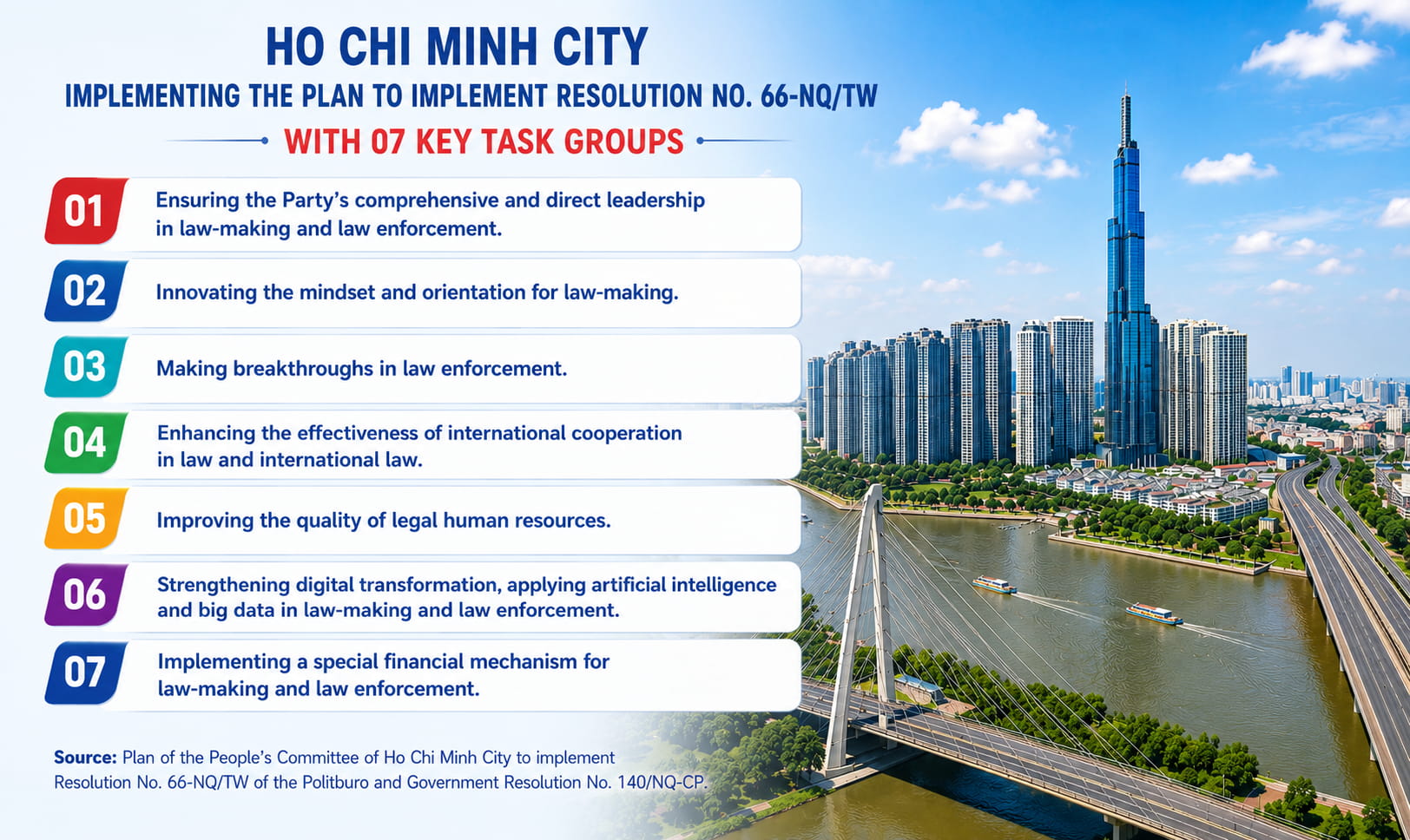
- Enhancing Digital Transformation, AI Application, and Big Data
Ho Chi Minh City prioritizes investment in information technology infrastructure and big data development, while promoting the application of digital technology and artificial intelligence in law-making and enforcement work. The Plan also requires the synchronous deployment of digital transformation in legal dissemination, education, legal aid, and professional activities, ensuring that data is connected, exploited effectively, and secured.
- Implementing Special Financial Mechanisms for Law-Making and Enforcement Work
The Plan requires innovating the mechanism for allocating, managing, and utilizing the budget for law-making and enforcement work in a timely, correct, and sufficient manner, closely linked to performance outcomes. Concurrently, it enhances the autonomy and accountability of the heads of agencies in managing and utilizing the allocated funds in accordance with regulations.