In the context of the unique solidarity between the Socialist Republic of Vietnam and the Lao People's Democratic Republic, this bilateral friendship has developed into a model of significant, devoted, and all-encompassing subnational cooperation over the course of more than 20 years of close cooperation. With a strong emphasis on high-tech agricultural development, border corridor trade connectivity, and the expansion of profound intellectual, healthcare, and educational exchanges, the two localities, which are strategic economic hubs, have developed a broad partnership that consistently translates diplomatic commitments into a number of useful action projects.
In terms of its economics and main advantages, Champasak is the most important commercial, tourism, and economic center in the Southern Laotian region. It is situated at the crucial border intersection of Laos, Thailand, and Cambodia. With a total GRDP of LAK 172,653 billion for the 2021–2025 period, the province's economy has grown rapidly, averaging 5.45% annual growth. In addition to border trade services (international logistics via the Vang Tao-Chong Mek border gate pair) and an impressively expanding tourism sector that brings in close to USD 100 million, Champasak's core strengths are firmly rooted in high-tech agriculture, which is highlighted by its status as the superior Arabica coffee capital on the Bolaven Plateau. In the new era, Champasak is undergoing a profound transformation by optimizing its potential in hydroelectric energy, agricultural processing, and green economy development integrated with the Mekong River ecosystem.
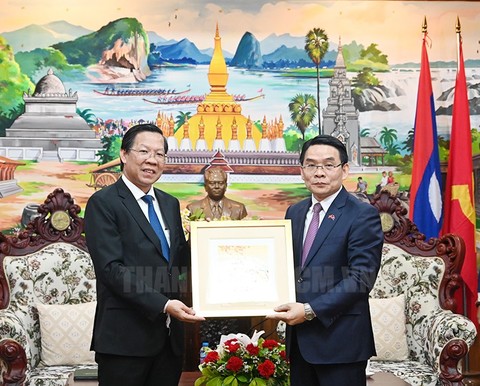
Former Chairman of the Ho Chi Minh City People's Committee Phan Van Mai presents a diplomatic gift to the Secretary of the Provincial Party Committee and Governor of Champasak, Mr. Vilayvong Bouddakham - Photo: Cong An Newspaper
In the areas of healthcare, education, agriculture, and infrastructure investment, the two communities' collaborative accomplishments over the past 20 years have proven to be extremely significant and all-encompassing. As demonstrated by cooperative projects creating expansive coffee cultivation areas of up to 5,000 hectares on the Bolaven Plateau, the bilateral trade corridor has been steadily strengthened and is a major factor in direct investment flows from major corporations in Ho Chi Minh City into Champasak. Recent useful social welfare initiatives, such as sending medical delegations from Ho Chi Minh City to conduct public health screenings, funding scholarships to develop top-notch human resources for the province, and increasing trade connectivity through business forums, have laid the groundwork for a significant new chapter in the two localities' relationship.
In order to draw in direct investment and establish strategic partnerships with partners from Champasak Province in five crucial areas, Ho Chi Minh City is growing its networks of partnerships, especially in light of its recently expanded sustainable development space:
1. High-Tech Agriculture and Agricultural Processing: Promoting the transfer of modern cultivation techniques, expanding and standardizing supply chain linkages for large-scale agricultural and forestry projects (coffee, fruit trees), and adding value to agricultural products from the Bolaven Plateau.
2. Logistics and Border Trade Infrastructure: Optimizing cross-border logistics supply chains and enhancing transport infrastructure connectivity along the East-West Economic Corridor through the Vang Tao - Chong Mek border gate.
3. Manufacturing and Supporting Industries: Attracting enterprises to jointly invest in, effectively utilize infrastructure, and share management solutions at specialized industrial sub-zones, notably the Pakse-Japan SME Special Economic Zone.
4. Eco-Tourism and Cultural Exchange (MICE): Collaborating on the joint creation of unique inter-regional travel routes, exploiting the potential of cultural tourism integrated with the UNESCO World Heritage site (Wat Phou Temple) and the Mekong River ecosystem (Si Phan Don).
5. Healthcare, Education and Training, and Green Energy: Continuing to expand the scale of cooperation in training high-quality human resources, transferring specialized medical technical solutions, and conducting joint research on renewable energy models and carbon emission reductions adapted to climate change.