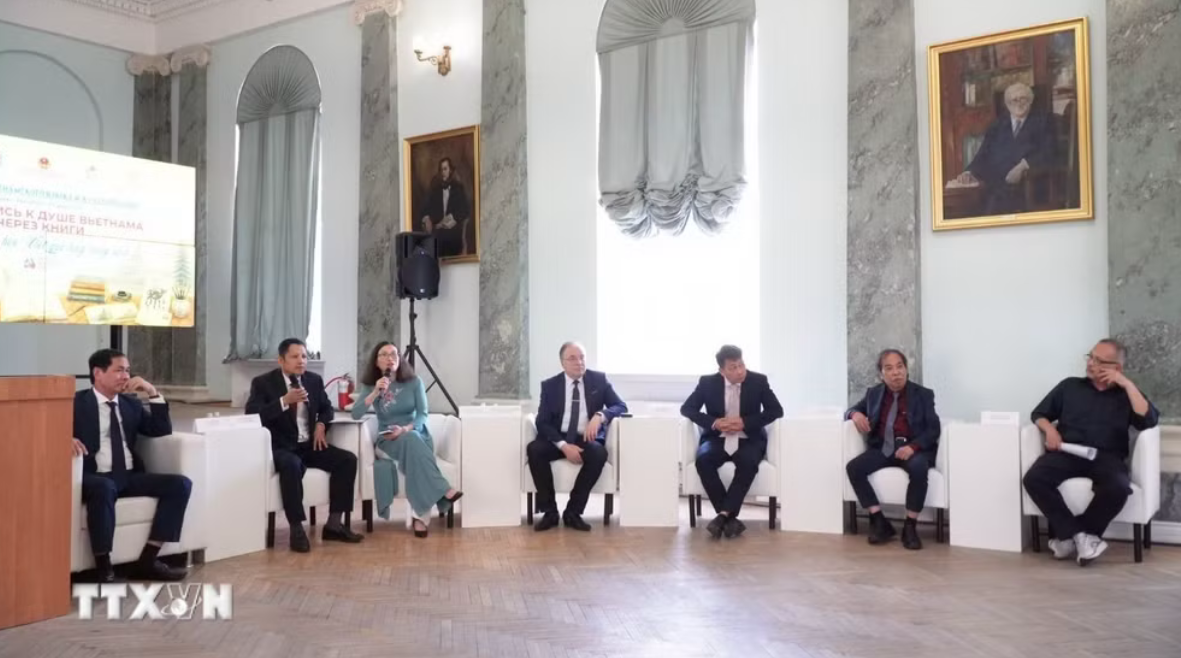
Photo: A seminar entitled “The Man Called the Symbol of Wisdom” held in Vladivostok, Russian Federation.
Photo: Vietnam News Agency (VNA)
In terms of economic development and key industries, Vladivostok is a major port city in the Russian Far East, with a population of more than 600,000. Serving as Russia's gateway to the Pacific Ocean, the city occupies a strategic location on the Muravyov-Amursky Peninsula, overlooking the Sea of Japan and situated in close proximity to the economies of Northeast Asia. Vladivostok's economy is driven by its strengths in seaports, logistics, trade, fisheries, maritime transport, education, coastal tourism, and regional cooperation. As the administrative, economic, and service centre of Primorsky Krai, the city enjoys significant advantages in the development of the maritime economy, international transportation, cold-chain logistics, and trade connectivity between the Russian Federation and the Asia-Pacific region.
A key feature of cooperation between Ho Chi Minh City and Vladivostok is the shared commitment to expanding collaboration in economic development, trade, science, culture, sports, maritime transport, and official delegation exchanges. These areas of cooperation closely complement Ho Chi Minh City's development priorities, particularly as the City seeks to strengthen new partnerships in logistics, merchandise trade, the maritime economy, fisheries, and Asia–Europe market connectivity.
In addition, the Eastern Economic Forum (EEF), held annually in Vladivostok, has become a leading international platform for promoting the development of the Russian Far East and fostering economic cooperation with the Asia-Pacific region. For Ho Chi Minh City, the Forum represents a valuable platform for business networking and exploring potential partnerships in maritime transport, cold-chain logistics, fisheries, agricultural trade, coastal tourism, education, and investment promotion.
For Ho Chi Minh City, Vladivostok has the potential to serve as a strategic gateway for expanding cooperation with the Russian Far East. The two cities possess complementary strengths in three key areas: port connectivity and logistics; fisheries, agricultural trade and cold-chain supply chains; and cooperation in education, culture and tourism. With its strategic location on the Pacific coast, extensive experience in hosting international cooperation platforms, and well-established maritime economy, Vladivostok is well positioned to support Ho Chi Minh City's efforts to broaden its partnership network across the Russian Far East while creating new opportunities for businesses on both sides to access emerging markets.
Looking ahead, particularly within the framework of the 3rd Ho Chi Minh City Friendship Dialogue (FD 2026), Ho Chi Minh City aims to broaden its cooperation framework with Vladivostok by encouraging investment, technology transfer, and the sharing of management expertise in the following five priority areas:
Logistics and Maritime Transport: Strengthen connectivity between the Port of Vladivostok and logistics hubs in southern Viet Nam, while promoting maritime transport, merchandise trade, warehousing, and international logistics services.
Fisheries and Cold-Chain Supply Chains: Promote cooperation in seafood preservation, processing, cold-chain transportation, product standardization, and the expansion of food trade between the two markets.
Maritime Economy and Coastal Tourism: Enhance collaboration in the development of coastal tourism products, cultural exchanges, destination promotion, and the sharing of best practices in the sustainable development of coastal areas.
Education, Regional Studies and People-to-People Exchanges:Strengthen partnerships among educational and research institutions specializing in Asia-Pacific studies, logistics, the maritime economy, languages, culture, and international relations, while promoting academic and people-to-people exchanges.
The Russian Far East Economy and Investment Promotion:Leverage international platforms such as the Eastern Economic Forum (EEF) to identify investment opportunities, foster business partnerships, and expand cooperation in trade, energy, logistics, and services.